

Which Person Is Drawing On Piaget's Theory In His/her Teaching?
Piaget'due south theory of cerebral development is a comprehensive theory about the nature and development of human intelligence. Piaget believed that one'south babyhood plays a vital and active function in a person's development.[i] Piaget'southward idea is primarily known equally a developmental stage theory. The theory deals with the nature of noesis itself and how humans gradually come to larn, construct, and apply it.[2] To Piaget, cognitive development was a progressive reorganization of mental processes resulting from biological maturation and ecology feel. He believed that children construct an understanding of the world effectually them, feel discrepancies between what they already know and what they detect in their environment, and so adjust their ideas accordingly.[iii] Moreover, Piaget claimed that cognitive development is at the center of the human being organism, and language is contingent on noesis and agreement acquired through cerebral development.[iv] Piaget'south earlier work received the greatest attention. Many parents have been encouraged to provide a rich, supportive surroundings for their kid'southward natural propensity to grow and learn. Child-centered classrooms and "open up education" are directly applications of Piaget's views.[5] Despite its huge success, Piaget's theory has some limitations that Piaget recognized himself: for instance, the theory supports sharp stages rather than continuous development (decalage).[6]
Nature of intelligence: operative and figurative
Piaget noted that reality is a dynamic system of continuous change and, as such, is defined in reference to the two weather that define dynamic systems. Specifically, he argued that reality involves transformations and states.[7]Transformations refer to all manners of changes that a thing or person tin can undergo.States refer to the conditions or the appearances in which things or persons can be institute between transformations. For example, there might be changes in shape or course (for instance, liquids are reshaped as they are transferred from one vessel to another, and similarly humans alter in their characteristics as they abound older), in size (for case, a series of coins on a table might be placed close to each other or far apart), or in placement or location in space and time (e.g., diverse objects or persons might be plant at 1 identify at one time and at a different identify at another fourth dimension). Thus, Piaget argued, if man intelligence is to exist adaptive, information technology must have functions to represent both the transformational and the static aspects of reality.[8] He proposed that operative intelligence is responsible for the representation and manipulation of the dynamic or transformational aspects of reality, and that figurative intelligence is responsible for the representation of the static aspects of reality.[9]
Operative intelligence is the active aspect of intelligence. It involves all actions, overt or covert, undertaken in order to follow, recover, or anticipate the transformations of the objects or persons of interest.[10]Figurative intelligence is the more than or less static aspect of intelligence, involving all means of representation used to retain in mind us (i.east., successive forms, shapes, or locations) that intervene between transformations. That is, information technology involves perception, imitation, mental imagery, drawing, and language.[xi] Therefore, the figurative aspects of intelligence derive their meaning from the operative aspects of intelligence, because states cannot exist independently of the transformations that interconnect them. Piaget stated that the figurative or the representational aspects of intelligence are subservient to its operative and dynamic aspects, and therefore, that understanding substantially derives from the operative aspect of intelligence.[ten]
At any time, operative intelligence frames how the globe is understood and it changes if understanding is not successful. Piaget stated that this procedure of understanding and alter involves two basic functions:assimilation andaccommodation.[11] [12] [13] [14]
Assimilation and accommodation
Through his study of the field of education, Piaget focused on ii processes, which he named assimilation and adaptation. To Piaget, assimilation meant integrating external elements into structures of lives or environments, or those we could take through feel.Assimilation is how humans perceive and adapt to new information. Information technology is the procedure of fitting new data into pre-existing cognitive schemas.[15]Assimilation in which new experiences are reinterpreted to fit into, or assimilate with, onetime ideas.[16] It occurs when humans are faced with new or unfamiliar data and refer to previously learned information in gild to make sense of it. In contrast,accommodation is the process of taking new information in one's environment and altering pre-existing schemas in guild to fit in the new data. This happens when the existing schema (knowledge) does not piece of work, and needs to be inverse to deal with a new object or situation.[17] Accommodation is imperative because it is how people will continue to interpret new concepts, schemas, frameworks, and more.[18] Piaget believed that the human brain has been programmed through evolution to bring equilibrium, which is what he believed ultimately influences structures past the internal and external processes through assimilation and accommodation.[xv]
Piaget's agreement was that assimilation and accommodation cannot be without the other.[19] They are 2 sides of a coin. To assimilate an object into an existing mental schema, one first needs to take into account or accommodate to the particularities of this object to a certain extent. For instance, to recognize (assimilate) an apple as an apple, one must first focus (adapt) on the profile of this object. To do this, one needs to roughly recognize the size of the object. Development increases the balance, or equilibration, between these ii functions. When in balance with each other, assimilation and accommodation generate mental schemas of the operative intelligence. When one role dominates over the other, they generate representations which vest to figurative intelligence.[xx]
Sensory-motor phase
Cognitive development is Jean Piaget's theory. Through a series of stages, Piaget proposed four stages of cognitive development: thesensorimotor,preoperational,concrete operational andformal operational period.[21] Thesensorimotor phase is the first of the four stages in cognitive development which "extends from birth to the acquisition of language".[22] In this stage, infants progressively construct knowledge and understanding of the globe by coordinating experiences (such every bit vision and hearing) with physical interactions with objects (such as grasping, sucking, and stepping).[23] Infants gain knowledge of the world from the concrete actions they perform within it.[24] They progress from reflexive, instinctual action at birth to the beginning of symbolic thought toward the stop of the stage.[24]
Children learn that they are split from the environment. They can think well-nigh aspects of the environment, even though these may exist outside the reach of the child's senses. In this phase, according to Piaget, the evolution of object permanence is 1 of the virtually important accomplishments.[15]Object permanence is a child'south agreement that objects go on to exist even though he or she cannot run into or hear them.[24] Peek-a-boo is a good test for that. By the finish of the sensorimotor catamenia, children develop a permanent sense of cocky and object.[25]

The states Navy 100406-Northward-7478G-346 Operations Specialist 2nd Class Reginald Harlmon and Electronics Technician 3rd Class Maura Schulze play peek-a-boo with a child in the Children'southward Ward at Infirmary Likas
Piaget divided the sensorimotor stage into 6 sub-stages".[25]
| Sub-Phase | Age | Description |
|---|---|---|
| 1Simple Reflexes | Birth-6 weeks | "Coordination of sensation and action through reflexive behaviors".[25] Three primary reflexes are described past Piaget: sucking of objects in the mouth, following moving or interesting objects with the eyes, and closing of the paw when an object makes contact with the palm (palmar grasp). Over the kickoff six weeks of life, these reflexes brainstorm to become voluntary actions. For case, the palmar reflex becomes intentional grasping.[26] |
| iiFirst habits and principal circular reactions phase | 6 weeks-four months | "Coordination of sensation and two types of schema: habits (reflex) and main circular reactions (reproduction of an event that initially occurred by adventure). The chief focus is yet on the babe's torso".[25] Equally an example of this type of reaction, an baby might repeat the motion of passing their hand earlier their face. Also at this phase, passive reactions, caused by classical or operant conditioning, can begin.[26] |
| 3Secondary circular reactions stage | four–8 months | Development of habits. "Infants become more object-oriented, moving beyond self-preoccupation; repeat actions that bring interesting or pleasurable results".[25] This stage is associated primarily with the development of coordination between vision and prehension. Three new abilities occur at this stage: intentional grasping for a desired object, secondary circular reactions, and differentiations between ends and ways. At this stage, infants will intentionally grasp the air in the direction of a desired object, often to the amusement of friends and family. Secondary circular reactions, or the repetition of an action involving an external object begin; for case, moving a switch to turn on a light repeatedly. The differentiation between means and ends also occurs. This is perhaps ane of the near important stages of a child'due south growth equally it signifies the dawn of logic.[26] |
| 4Coordination of secondary circular reactions stages | 8–12 months | "Coordination of vision and affect—hand-eye coordination; coordination of schemas and intentionality".[25] This stage is associated primarily with the development of logic and the coordination between means and ends. This is an extremely important stage of development, belongings what Piaget calls the "first proper intelligence". Besides, this stage marks the offset of goal orientation, the deliberate planning of steps to come across an objective.[26] |
| 5Tertiary circular reactions, novelty, and curiosity | 12–eighteen months | "Infants become intrigued by the many backdrop of objects and by the many things they can make happen to objects; they experiment with new beliefs".[25] This stage is associated primarily with the discovery of new means to see goals. Piaget describes the kid at this juncture as the "immature scientist," conducting pseudo-experiments to detect new methods of coming together challenges.[26] |
| viInternalization of Schemas | 18–24 months | "Infants develop the ability to use primitive symbols and class enduring mental representations".[25]This stage is associated primarily with the ancestry of insight, or true creativity. This marks the passage into the preoperational phase. |
Pre-operational stage
Piaget'southward second stage, the pre-operational stage, starts when the child begins to learn to speak at age two and lasts upwardly until the age of seven. During the Pre-operational Phase of cognitive development, Piaget noted that children do not yet understand concrete logic and cannot mentally dispense data.[27] Children's increase in playing and pretending takes identify in this stage. However, the child notwithstanding has trouble seeing things from different points of view. The children's play is mainly categorized by symbolic play and manipulating symbols. Such play is demonstrated by the idea of checkers beingness snacks, pieces of paper beingness plates, and a box being a tabular array. Their observations of symbols exemplifies the idea of play with the absence of the actual objects involved. By observing sequences of play, Piaget was able to demonstrate that, towards the stop of the 2nd year, a qualitatively new kind of psychological functioning occurs, known as the Pre-operational Stage.[28] [29]
The pre-operational stage is sparse and logically inadequate in regard to mental operations. The child is able to form stable concepts equally well as magical beliefs. The child, however, is still non able to perform operations, which are tasks that the kid can practise mentally, rather than physically. Thinking in this phase is still egocentric, meaning the child has difficulty seeing the viewpoint of others. The Pre-operational Phase is split into two substages: the symbolic function substage, and the intuitive thought substage. The symbolic function substage is when children are able to understand, correspond, remember, and picture show objects in their mind without having the object in front end of them. The intuitive thought substage is when children tend to propose the questions of "why?" and "how come?" This phase is when children desire the knowledge of knowing everything.[29]
Symbolic function substage
At about 2 to 4 years of age, children cannot nonetheless manipulate and transform information in a logical way. However, they now can remember in images and symbols. Other examples of mental abilities are language and pretend play. Symbolic play is when children develop imaginary friends or function-play with friends. Children'south play becomes more than social and they assign roles to each other. Some examples of symbolic play include playing business firm, or having a tea party. Interestingly, the type of symbolic play in which children engage is continued with their level of inventiveness and ability to connect with others.[30] Additionally, the quality of their symbolic play can accept consequences on their later development. For example, young children whose symbolic play is of a violent nature tend to exhibit less prosocial behavior and are more likely to display antisocial tendencies in later years.[31]
In this stage, there are still limitations, such as egocentrism and precausal thinking.
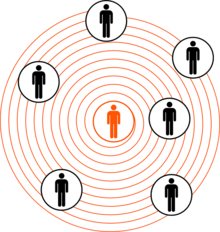
Egocentrism occurs when a kid is unable to distinguish between their own perspective and that of another person. Children tend to stick to their ain viewpoint, rather than consider the view of others. Indeed, they are non even enlightened that such a concept as "different viewpoints" exists.[32] Egocentrism can exist seen in an experiment performed by Piaget and Swiss developmental psychologist Bärbel Inhelder, known as the three-mountain problem. In this experiment, 3 views of a mount are shown to the child, who is asked what a traveling doll would see at the diverse angles. The child will consistently describe what they can meet from the position from which they are seated, regardless of from what angle they are asked to take the doll'due south perspective. Egocentrism would also crusade a child to believe, "I likeSesame Street, so Daddy must similarSesame Street, as well".
Similar to preoperational children's egocentric thinking is their structuring of a cause and effect relationships. Piaget coined the term "precausal thinking" to depict the mode in which preoperational children employ their own existing ideas or views, like in egocentrism, to explain crusade-and-effect relationships. Three main concepts of causality equally displayed by children in the preoperational stage include: animism, artificialism and transductive reasoning.[33]
Animism is the belief that inanimate objects are capable of actions and take lifelike qualities. An example could be a child assertive that the sidewalk was mad and made them fall downwardly, or that the stars twinkle in the heaven because they are happy. Artificialism refers to the belief that ecology characteristics can be attributed to human actions or interventions. For case, a child might say that it is windy outside because someone is bravado very hard, or the clouds are white because someone painted them that color. Finally, precausal thinking is categorized by transductive reasoning. Transductive reasoning is when a child fails to understand the truthful relationships betwixt crusade and effect.[29] [34] Dissimilar deductive or inductive reasoning (general to specific, or specific to general), transductive reasoning refers to when a child reasons from specific to specific, drawing a relationship between two dissever events that are otherwise unrelated. For example, if a kid hears the dog bawl and and so a balloon popped, the child would conclude that because the domestic dog barked, the balloon popped.
Intuitive thought substage
At between well-nigh the ages of 4 and vii, children tend to go very curious and ask many questions, get-go the use of primitive reasoning. There is an emergence in the interest of reasoning and wanting to know why things are the manner they are. Piaget called it the "intuitive substage" because children realize they take a vast amount of noesis, merely they are unaware of how they caused it. Centration, conservation, irreversibility, class inclusion, and transitive inference are all characteristics of preoperative idea. Centration is the deed of focusing all attention on one characteristic or dimension of a state of affairs, whilst disregarding all others. Conservation is the sensation that altering a substance's appearance does not alter its bones properties. Children at this stage are unaware of conservation and exhibit centration. Both centration and conservation can be more than easily understood in one case familiarized with Piaget'due south most famous experimental task.
In this task, a child is presented with two identical beakers containing the same amount of liquid. The child usually notes that the beakers do contain the same amount of liquid. When one of the beakers is poured into a taller and thinner container, children who are younger than seven or eight years sometime typically say that the two beakers no longer incorporate the aforementioned amount of liquid, and that the taller container holds the larger quantity (centration), without taking into consideration the fact that both beakers were previously noted to comprise the same amount of liquid. Due to superficial changes, the child was unable to comprehend that the properties of the substances connected to remain the aforementioned (conservation).
Irreversibility is a concept adult in this stage which is closely related to the ideas of centration and conservation. Irreversibility refers to when children are unable to mentally opposite a sequence of events. In the same beaker situation, the child does non realize that, if the sequence of events was reversed and the h2o from the alpine beaker was poured dorsum into its original beaker, then the same amount of water would exist. Another example of children'south reliance on visual representations is their misunderstanding of "less than" or "more than than". When two rows containing equal amounts of blocks are placed in front of a kid, one row spread farther autonomously than the other, the child will remember that the row spread farther contains more blocks.[29] [35]
Class inclusion refers to a kind of conceptual thinking that children in the preoperational phase cannot yet grasp. Children's inability to focus on two aspects of a situation at in one case inhibits them from understanding the principle that i category or class can contain several unlike subcategories or classes.[33] For case, a 4-yr-old girl may exist shown a film of eight dogs and three cats. The girl knows what cats and dogs are, and she is aware that they are both animals. However, when asked, "Are there more dogs or animals?" she is likely to answer "more dogs". This is due to her difficulty focusing on the ii subclasses and the larger course all at the same fourth dimension. She may have been able to view the dogs as dogsor animals, merely struggled when trying to allocate them every bit both, simultaneously.[36] [37] Similar to this is concept relating to intuitive thought, known equally "transitive inference".
Transitive inference is using previous knowledge to make up one's mind the missing piece, using basic logic. Children in the preoperational stage lack this logic. An example of transitive inference would be when a child is presented with the data "A" is greater than "B" and "B" is greater than "C". This child may accept difficulty here agreement that "A" is also greater than "C".
Physical operational stage
Theconcrete operational stage is the tertiary stage of Piaget's theory of cognitive development. This stage, which follows the preoperational stage, occurs between the ages of 7 and 11 (preadolescence) years,[38] and is characterized past the appropriate apply of logic. During this stage, a child's thought processes become more than mature and "developed like". They start solving bug in a more than logical mode. Abstract, hypothetical thinking is not yet developed in the child, and children can merely solve problems that apply to concrete events or objects. At this phase, the children undergo a transition where the child learns rules such as conservation.[39] Piaget determined that children are able to contain Inductive reasoning. Inductive reasoning involves drawing inferences from observations in gild to make a generalization. In contrast, children struggle with deductive reasoning, which involves using a generalized principle in club to attempt to predict the event of an event. Children in this phase commonly feel difficulties with figuring out logic in their heads. For example, a kid will empathise that "A is more than than B" and "B is more C". However, when asked "is A more than than C?", the kid might not be able to logically figure the question out in his or her head.
Two other important processes in the concrete operational stage are logic and the elimination of egocentrism.
Egocentrism is the inability to consider or understand a perspective other than one's own. It is the phase where the idea and morality of the child is completely self focused.[40] During this stage, the child acquires the power to view things from another individual's perspective, fifty-fifty if they think that perspective is wrong. For instance, show a child a comic in which Jane puts a doll nether a box, leaves the room, and then Melissa moves the doll to a drawer, and Jane comes back. A child in the physical operations stage will say that Jane volition nonetheless call up it'south nether the box even though the child knows it is in the drawer. (See also False-belief task.)
Children in this stage can, however, only solve bug that utilize to actual (concrete) objects or events, and not abstruse concepts or hypothetical tasks. Understanding and knowing how to use total common sense has not yet been completely adjusted.
Piaget determined that children in the physical operational stage were able to incorporate inductive logic. On the other hand, children at this historic period have difficulty using deductive logic, which involves using a full general principle to predict the outcome of a specific event. This includes mental reversibility. An example of this is being able to reverse the society of relationships betwixt mental categories. For example, a child might exist able to recognize that his or her domestic dog is a Labrador, that a Labrador is a dog, and that a dog is an animal, and draw conclusions from the information available, as well as use all these processes to hypothetical situations.[41]
The abstract quality of the adolescent's idea at the formal operational level is evident in the boyish's verbal trouble solving power.[41] The logical quality of the adolescent'south thought is when children are more likely to solve bug in a trial-and-error manner.[41] Adolescents brainstorm to think more than as a scientist thinks, devising plans to solve problems and systematically test opinions.[41] They utilise hypothetical-deductive reasoning, which means that they develop hypotheses or best guesses, and systematically deduce, or conclude, which is the best path to follow in solving the problem.[41] During this phase the adolescent is able to understand love, logical proofs and values. During this stage the young person begins to entertain possibilities for the future and is fascinated with what they tin can be.[41]
Adolescents also are changing cognitively by the way that they call back about social matters.[41] Boyish egocentrism governs the way that adolescents think most social matters, and is the heightened cocky-consciousness in them as they are, which is reflected in their sense of personal uniqueness and invincibility.[41] Boyish egocentrism tin can be dissected into two types of social thinking, imaginary audience that involves attention-getting behavior, and personal fable, which involves an boyish's sense of personal uniqueness and invincibility.[41] These ii types of social thinking brainstorm to bear upon a child's egocentrism in the concrete stage. Nonetheless, information technology carries over to the formal operational stage when they are and then faced with abstruse thought and fully logical thinking.
Testing for physical operations
Piagetian tests are well known and adept to exam for concrete operations. The nigh prevalent tests are those for conservation. There are some important aspects that the experimenter must take into business relationship when performing experiments with these children.
One instance of an experiment for testing conservation is an experimenter will accept ii glasses that are the same size, make full them to the same level with liquid, which the kid will admit is the same. Then, the experimenter will cascade the liquid from one of the small spectacles into a tall, thin glass. The experimenter will and then ask the kid if the taller drinking glass has more than liquid, less liquid, or the same corporeality of liquid. The child volition then give his respond. The experimenter will ask the kid why he gave his respond, or why he thinks that is.
- Justification: Afterward the kid has answered the question being posed, the experimenter must ask why the kid gave that answer. This is important considering the answers they requite can help the experimenter to assess the child'due south developmental age.[42]
- Number of times asking: Some argue that if a child is asked if the amount of liquid in the starting time set of glasses is equal then, afterward pouring the water into the taller glass, the experimenter asks over again about the amount of liquid, the children volition start to doubt their original answer. They may get-go to recall that the original levels were not equal, which will influence their second answer.[43]
- Give-and-take Pick: The phrasing that the experimenter uses may affect how the child answers. If, in the liquid and drinking glass case, the experimenter asks, "Which of these spectacles has more liquid?", the child may think that his thoughts of them being the same is wrong because the adult is saying that one must have more than. Alternatively, if the experimenter asks, "Are these equal?", and then the kid is more than likely to say that they are, because the experimenter is implying that they are.

Formal operational phase
The concluding phase is known every bit theformal operational stage (adolescence and into adulthood, roughly ages 11 to approximately 15-20): Intelligence is demonstrated through the logical use of symbols related to abstract concepts. This course of thought includes "assumptions that have no necessary relation to reality."[44] At this signal, the person is capable of hypothetical and deductive reasoning. During this time, people develop the ability to call back about abstract concepts.
Piaget stated that "hypothetico-deductive reasoning" becomes important during the formal operational stage. This type of thinking involves hypothetical "what-if" situations that are not e'er rooted in reality, i.e. counterfactual thinking. It is oft required in science and mathematics.
- Abstract thought emerges during the formal operational stage. Children tend to recollect very concretely and specifically in before stages, and begin to consider possible outcomes and consequences of actions.
- Metacognition, the chapters for "thinking about thinking" that allows adolescents and adults to reason about their thought processes and monitor them.[45]
- Problem-solving is demonstrated when children use trial-and-mistake to solve problems. The ability to systematically solve a trouble in a logical and methodical manner emerges.
While children in principal schoolhouse years mostly used inductive reasoning, drawing general conclusions from personal experiences and specific facts, adolescents become capable of deductive reasoning, in which they describe specific conclusions from abstract concepts using logic. This capability results from their capacity to think hypothetically.[46]
"However, enquiry has shown that not all persons in all cultures reach formal operations, and most people practise not employ formal operations in all aspects of their lives".[47]
Experiments
Piaget and his colleagues conducted several experiments to assess formal operational thought.[48]
In 1 of the experiments, Piaget evaluated the cognitive capabilities of children of unlike ages through the use of a scale and varying weights. The task was to balance the scale by hooking weights on the ends of the calibration. To successfully complete the task, the children must use formal operational thought to realize that the altitude of the weights from the middle and the heaviness of the weights both affected the residue. A heavier weight has to be placed closer to the center of the scale, and a lighter weight has to be placed farther from the middle, so that the 2 weights residue each other.[46] While 3- to v- year olds could not at all comprehend the concept of balancing, children by the historic period of 7 could residual the scale past placing the aforementioned weights on both ends, only they failed to realize the importance of the location. Past historic period 10, children could call up virtually location merely failed to use logic and instead used trial-and-error. Finally, past historic period 13 and 14, in early adolescence, some children more clearly understood the human relationship betwixt weight and altitude and could successfully implement their hypothesis.[49]
Example of Piaget's conservation tasks
The stages and causation
Piaget sees children'southward formulation of causation every bit a march from "archaic" conceptions of cause to those of a more scientific, rigorous, and mechanical nature. These archaic concepts are characterized as supernatural, with a decidedly non-natural or non-mechanical tone. Piaget has equally his most basic assumption that babies are phenomenists. That is, their noesis "consists of assimilating things to schemas" from their own action such that they appear, from the child's point of view, "to have qualities which, in fact, stalk from the organism". Consequently, these "subjective conceptions," then prevalent during Piaget's kickoff stage of development, are dashed upon discovering deeper empirical truths.
Piaget gives the case of a child believing that the moon and stars follow him on a night walk. Upon learning that such is the case for his friends, he must separate his cocky from the object, resulting in a theory that the moon is immobile, or moves independently of other agents.
The 2d phase, from around three to viii years of age, is characterized by a mix of this blazon of magical, animistic, or "non-natural" conceptions of causation and mechanical or "naturalistic" causation. This conjunction of natural and not-natural causal explanations supposedly stems from experience itself, though Piaget does not make much of an attempt to draw the nature of the differences in formulation. In his interviews with children, he asked questions specifically nearly natural phenomena, such as: "What makes clouds move?", "What makes the stars movement?", "Why exercise rivers flow?" The nature of all the answers given, Piaget says, are such that these objects must perform their deportment to "fulfill their obligations towards men". He calls this "moral caption".[l]
Applied applications
Parents can utilize Piaget's theory when deciding how to determine what to buy in order to support their child'southward growth.[51] Teachers can besides apply Piaget'south theory, for instance, when discussing whether the syllabus subjects are suitable for the level of students or not.[52] For case, recent studies take shown that children in the aforementioned class and of the same age perform differentially on tasks measuring bones addition and subtraction fluency. While children in the preoperational and concrete operational levels of cerebral development perform combined arithmetic operations (such as addition and subtraction) with like accurateness,[53] children in the concrete operational level of cognitive development have been able to perform both addition problems and subtraction bug with overall greater fluency.[54]
The phase of cerebral growth of a person differ from another. It affects and influences how someone thinks about everything including flowers. A vii-calendar month old infant, in the sensorimotor age, flowers are recognized by smelling, pulling and biting. A slightly older child has non realized that a flower is not fragrant, merely similar to many children at her age, her egoistic, 2 handed curiosity will teach her. In the formal operational stage of an adult, flowers are part of larger, logical scheme. They are used either to earn coin or to create beauty. Cognitive development or thinking is an active process from the beginning to the end of life. Intellectual advocacy happens considering people at every age and developmental menstruum looks for cognitive equilibrium. To achieve this remainder, the easiest way is to empathise the new experiences through the lens of the preexisting ideas. Infants larn that new objects tin be grabbed in the aforementioned fashion of familiar objects, and adults explain the day'due south headlines every bit testify for their existing worldview.[55]
However, the awarding of standardized Piagetian theory and procedures in different societies established widely varying results that lead some to speculate not only that some cultures produce more cognitive development than others but that without specific kinds of cultural experience, simply besides formal schooling, evolution might cease at certain level, such as concrete operational level. A procedure was washed post-obit methods developed in Geneva. Participants were presented with two beakers of equal circumference and height, filled with equal amounts of h2o. The water from i beaker was transferred into another with taller and smaller circumference. The children and young adults from not-literate societies of a given age were more likely to call up that the taller, thinner beaker had more than water in information technology. On the other hand, an experiment on the furnishings of modifying testing procedures to match local cultural produced a different design of results.[56]
Postulated physical mechanisms underlying schemas and stages
In 1967, Piaget considered the possibility of RNA molecules equally likely embodiments of his nevertheless-abstract schemas (which he promoted as units of action)—though he did not come to whatsoever firm conclusion.[57] At that time, due to work such as that of Swedish biochemist Holger Hydén, RNA concentrations had, indeed, been shown to correlate with learning, so the idea was quite plausible.
Nevertheless, past the time of Piaget's death in 1980, this notion had lost favor. One main trouble was over the poly peptide which, it was assumed, such RNA would necessarily produce, and that did not fit in with observation. It was determined that but about three% of RNA does code for protein.[58] Hence, nearly of the remaining 97% (the "ncRNA") could theoretically exist bachelor to serve every bit Piagetian schemas (or other regulatory roles in the 2000s under investigation). The issue has not yet been resolved experimentally, but its theoretical aspects were reviewed in 2008[58] — then adult farther from the viewpoints of biophysics and epistemology.[59] [lx] Meanwhile, this RNA-based approach also unexpectedly offered explanations for other several biological issues unresolved, thus providing some measure of corroboration.
Relation to psychometric theories of intelligence
Piaget designed a number of tasks to verify hypotheses arising from his theory. The tasks were not intended to measure individual differences, and they have no equivalent in psychometric intelligence tests. Notwithstanding the different research traditions in which psychometric tests and Piagetian tasks were developed, the correlations betwixt the two types of measures accept been found to be consistently positive and generally moderate in magnitude. A common general factor underlies them. Information technology has been shown that it is possible to construct a battery consisting of Piagetian tasks that is equally expert a measure of general intelligence as standard IQ tests.[61] [62] [63]
Challenges to Piagetian Stage Theory
Piagetian accounts of development have been challenged on several grounds. Beginning, as Piaget himself noted, development does not ever progress in the smooth fashion his theory seems to predict. "Decalage," or progressive forms of cognitive developmental progression in a specific domain, propose that the stage model is, at best, a useful approximation.[64] Furthermore, studies have found that children may be able to learn concepts and adequacy of complex reasoning that supposedly represented in more than advanced stages with relative ease (Lourenço & Machado, 1996, p. 145).[65] [66] More than broadly, Piaget's theory is "domain general," predicting that cognitive maturation occurs concurrently across unlike domains of knowledge (such as mathematics, logic, and understanding of physics or language).[64] Piaget did not take into account variability in a child's performance notably how a child tin differ in sophistication across several domains.
During the 1980s and 1990s, cerebral developmentalists were influenced by "neo-nativist" and evolutionary psychology ideas. These ideas de-emphasized domain general theories and emphasized domain specificity or modularity of heed.[67] Modularity implies that different cognitive faculties may be largely independent of one another, and thus develop co-ordinate to quite unlike timetables, which are "influenced by existent globe experiences".[67] In this vein, some cerebral developmentalists argued that, rather than being domain general learners, children come equipped with domain specific theories, sometimes referred to as "core cognition," which allows them to break into learning within that domain. For example, even young infants appear to be sensitive to some predictable regularities in the movement and interactions of objects (for case, an object cannot laissez passer through some other object), or in man behavior (for instance, a paw repeatedly reaching for an object has that object, not just a particular path of movement), as information technology becomes the edifice cake of which more elaborate knowledge is constructed.
Piaget'due south theory has been said to undervalue the influence that culture has on cerebral evolution. Piaget demonstrates that a child goes through several stages of cognitive evolution and come up to conclusions on their ain merely in reality, a child's sociocultural environs plays an important role in their cognitive development. Social interaction teaches the child about the earth and helps them develop through the cognitive stages, which Piaget neglected to consider.[68]
More contempo work has strongly challenged some of the bones presumptions of the "core knowledge" school, and revised ideas of domain generality—but from a newer dynamic systems approach, not from a revised Piagetian perspective. Dynamic systems approaches harken to modern neuroscientific research that was not bachelor to Piaget when he was constructing his theory. One of import finding is that domain-specific knowledge is constructed as children develop and integrate knowledge. This enables the domain to amend the accuracy of the noesis as well equally organization of memories.[67] However, this suggests more of a "smoothen integration" of learning and development than either Piaget, or his neo-nativist critics, had envisioned. Additionally, some psychologists, such as Lev Vygotsky and Jerome Bruner, idea differently from Piaget, suggesting that language was more than important for cognition development than Piaget implied.[67] [69]
Post-Piagetian and Neo-Piagetian Stages
In recent years, several theorists attempted to address concerns with Piaget'southward theory by developing new theories and models that can accommodate evidence which violates Piagetian predictions and postulates.
- The neo-Piagetian theories of cerebral development, advanced by Robbie Case, Andreas Demetriou, Graeme S. Halford, Kurt W. Fischer, Michael Lamport Eatables, and Juan Pascual-Leone, attempted to integrate Piaget'south theory with cerebral and differential theories of cerebral system and evolution. Their aim was to improve account for the cerebral factors of development and for intra-individual and inter-individual differences in cerebral development. They suggested that development along Piaget's stages is due to increasing working memory capacity and processing efficiency past "biological maturation".[seventy] Moreover, Demetriou´southward theory ascribes an important role to hypercognitive processes of "self-monitoring, self-recording, self-evaluation, and self-regulation", and it recognizes the operation of several relatively democratic domains of thought (Demetriou, 1998; Demetriou, Mouyi, Spanoudis, 2022; Demetriou, 2003, p. 153).[71]
- Piaget'due south theory stops at the formal operational stage, just other researchers have observed the thinking of adults is more nuanced than formal operational thought. This fifth phase has been named postal service formal idea or operation.[72] [73] Post formal stages accept been proposed. Michael Commons presented bear witness for 4 post formal stages: systematic, meta-systematic, paradigmatic, and cantankerous-paradigmatic (Eatables & Richards, 2003, p. 206-208; Oliver, 2004, p. 31).[74] [75] [76] In that location are many theorists, all the same, who have criticized "postal service formal thinking," because the concept lacks both theoretical and empirical verification. The term "integrative thinking" has been suggested for use instead.[77] [78] [79] [lxxx] [81]

Kohlberg's Model of Moral Development
- A "sentential" stage, said to occur before the early preoperational phase, has been proposed by Fischer, Biggs and Biggs, Commons, and Richards.[82] [83]
- Searching for a micro-physiological basis for man mental capacity, Traill (1978, Section C5.iv [6]; – 1999, Section viii.iv [7]) proposed that there may be "pre-sensorimotor" stages ("M−1L", "K−2L", …), which are developed in the womb and/or transmitted genetically.
- Jerome Bruner has expressed views on cognitive development in a "pragmatic orientation" in which humans actively use knowledge for practical applications, such as problem solving and agreement reality.[84]
- Michael Lamport Eatables proposed the model of hierarchical complexity (MHC) in ii ways: "Horizontal Complication" and "Vertical Complexity" (Eatables & Richards, 2003, p. 205).[75] [85] [86]
- Kieran Egan has proposed five stages of understanding: "somatic", "mythic", "romantic", "philosophic", and "ironic", which is developed through cognitive tools such as "stories", "binary oppositions", "fantasy" and "rhyme, rhythm, and meter" to enhance memorization to develop a long-lasting learning capacity.[87]
- Lawrence Kohlberg developed three stages of moral development: "Preconventional", "Conventional" and "Postconventional".[87] [88] Each level is equanimous of two orientation stages, with a total of six orientation stages: (1) "Punishment-Obedience", (2) "Instrumental Relativist", (3) "Good Boy-Squeamish Girl", (4) "Police force and Lodge", (5) "Social Contract", and (6) "Universal Ethical Principle".[87] [88]
- Andreas Demetriou has expressed Neo-Piagetian theories of cognitive development.
- Jane Loevinger'southward stages of ego evolution occur through "an evolution of stages".[89] "Get-go is the Presocial Phase followed by the Symbiotic Stage, Impulsive Stage, Self-Protective Stage, Conformist Stage, Self-Aware Level: Transition from Conformist to Conscientious Phase, Individualistic Level: Transition from Conscientious to the Autonomous Stage, Conformist Stage, and Integrated Stage".[89]
- Ken Wilber has incorporated Piaget's theory in his multidisciplinary field of Integral Theory. The human consciousness is structured in hierarchical order and organized in "holon" chains or "Great chain of being", which are based on the level of spiritual and psychological development.[90]

Maslow'southward Hierarchy Of Needs
- The procedure of initiation is a modification of Piaget's theory integrating Abraham Maslow's concept of self-actualization.[91]
- Cheryl Armon has proposed five stages of " the Good Life": "Egoistic Hedonism", "Instrumental Hedonism", "Affective/Altruistic Mutuality", "Individuality", and "Autonomy/Community" (Andreoletti & Demick, 2003, p. 284) (Armon, 1984, p. twoscore-43).[92] [93]
- Christopher R. Hallpike proposed that human being evolution of cognitive moral understanding had evolved from the beginning of fourth dimension from its archaic state to the present time.[94] [95]
- Robert Kegan extended Piaget'southward developmental model to adults in describing the constructive developmental framework.[96]
References
- Jump up^ http://proxy.wexler.hunter.cuny.edu/login?url=/login?qurl=http://search.credoreference.com.proxy.wexler.hunter.cuny.edu/content/entry/conscitech/developmental_psychology/0
- Jump up^ Torres, J. and Ash, Grand. (2007). Cerebral evolution. In Encyclopedia of special education: A reference for the teaching of children, adolescents, and adults with disabilities and other exceptional individuals. Retrieved from http://proxy.wexler.hunter.cuny.edu/login?url=/login?qurl=http://search.credoreference.com.proxy.wexler.hunter.cuny.edu/content/entry/wileyse/cognitive_development/0
- Bound up^ McLeod, S. A. "Piaget | Cognitive Theory". Simply Psychology. Retrieved18 September 2012.
- Bound up^ Baldwin, J. (2005). Jean Piaget. In Cardinal thinkers in linguistics and the philosophy of language. Retrieved from http://proxy.wexler.hunter.cuny.edu/login?url=/login?qurl=http://search.credoreference.com/content/entry/edinburghthinkl/jean_piaget/0
- Spring up^ Bully Lives from History: The Twentieth Century; September 2008, p1-3
- Jump upwards^ Vocaliser-Freeman, Karen E. "Concrete Operational Period." Encyclopedia of Man Development. Ed. Neil J. Salkind. Vol. one. Thousand Oaks, CA: SAGE Reference, 2006. 291-292. Gale Virtual Reference Library. Web. 10 December. 2022.http://go.galegroup.com/ps/i.practice?id=GALE%7CCX3466300160&five=ii.1&u=cuny_hunter&it=r&p=GVRL&sw=w&asid=b6bd1ae3a4e93016b772396b5848a349
- Jump upward^ Piaget, J. (1977). The role of action in the development of thinking. In Noesis and development (pp. 17-42). Springer U.s..
- Jump upwardly^ Maréchal, G. (2010). Constructivism. In A. J. Mills, G. Durepos, & E. Wiebe (Eds.), Encyclopedia of Case Study Inquiry (Vol. 1, pp. 220-225). Thousand Oaks, CA: SAGE Reference. Retrieved from http://get.galegroup.com.proxy.wexler.hunter.cuny.edu/ps/i.do?id=GALE%7CCX1562500095&v=2.1&u=cuny_hunter&it=r&p=GVRL&sw=due west&asid=15311e6ee67b398da4f1a1967f58503d
- Bound upward^ Piaget, J., & Inhelder, B. (1973).Memory and intelligence. London: Routledge and Kegan Paul.
- ^Jump upwards to: a b Furth, H. G. (1977). The operative and figurative aspects of knowledge in Piaget'south theory. B. A. Geber (Ed.). London,, England: Routledge & Kegan Paul.
- ^Bound upwards to: a b Gruber, H. East. (2004). Piaget, Jean (1896-1980). In J. H. Byrne (Ed.), Learning and Retentivity (2nd ed., pp. 526-529). New York: Macmillan Reference USA. Retrieved from http://go.galegroup.com.proxy.wexler.hunter.cuny.edu/ps/i.practise?id=GALE%7CCX3407100185&v=2.ane&u=cuny_hunter&it=r&p=GVRL&sw=w&asid=b71fd57e9d31971ea40106f27e199015
- Jump up^ Assimilation. (2001). In B. Strickland (Ed.), The Gale Encyclopedia of Psychology (second ed., pp. 49-50). Detroit: Gale. Retrieved from http://get.galegroup.com.proxy.wexler.hunter.cuny.edu/ps/i.practise?id=GALE%7CCX3406000055&v=2.1&u=cuny_hunter&it=r&p=GVRL&sw=w&asid=174d9bd2c42c2e8475446e5c13301c8d
- Jump up^ Fox, J. E. (2006). Assimilation. In N. J. Salkind (Ed.), Encyclopedia of Human Development (Vol. one, pp. 118-119). Yard Oaks, CA: SAGE Reference. Retrieved from http://get.galegroup.com.proxy.wexler.hunter.cuny.edu/ps/i.do?id=GALE%7CCX3466300066&v=2.1&u=cuny_hunter&it=r&p=GVRL&sw=w&asid=ed09320c311b0c0e856cb2ce7c4cd810
- Jump up^ ELKIND, D. (2002). Piaget, Jean (1896–1980). In J. Westward. Guthrie (Ed.), Encyclopedia of Teaching (2nd ed., Vol. 5, pp. 1894-1898). New York: Macmillan Reference USA. Retrieved from http://go.galegroup.com.proxy.wexler.hunter.cuny.edu/ps/i.do?id=GALE%7CCX3403200491&five=2.1&u=cuny_hunter&information technology=r&p=GVRL&sw=w&asid=8de3eeb14aba519a97e788201dd42234
- ^Jump upward to: a b c Berger, Kathleen Stassen (2008).The developing person through the life span (7th ed.). Worth. p. 44. ISBN 9780716760801.
- Bound upward^ Berger, Kathleen Stassen (2008).The developing person through the life span (7th ed.). Worth. p. 45. ISBN 9780716760801.
- Bound up^ McLeod, Due south. A. (2009). Jean Piaget. Retrieved from http://www.simplypsychology.org/piaget.html
- Jump up^ "Block, Jack" "Assimilation, Accommodation, and the Dynamics of Personality Evolution"
- Bound up^ Block, Jack (1982). "Absorption, adaptation, and the dynamics of personality development".Child Evolution.53 (2): 281–295. doi:10.2307/1128971.
- Bound up^ http://etec512learningconference-piaget.weebly.com/theory.html
- Jump up^ Berger, Kathleen Stassen (2008).The developing person through the life span (7th ed.). Worth. p. 43. ISBN 9780716760801.
- Spring up^ Tuckman, Bruce W., and David M. Monetti. Educational Psychology. Belmont, CA: Wadsworth, 2022. Print
- Jump upwardly^ Bernstein, Penner, and Clarke-Stewart, Roy.Psychology Report Guide
- ^Leap up to: a b c "Sensorimotor Stage".
- ^Bound upward to: a b c d e f g h Santrock, J.Westward. (2008).A Topical Approach To Life-Span Development (pp.211-216). New York, NY: McGraw-Loma
- ^Jump up to: a b c d e Piaget, J. (1977). Gruber, H.E.; Voneche, J.J., eds.The essential Piaget. New York: Basic Books.
- Spring up^ http://psychology.about.com/od/piagetstheory/p/preoperational.htm
- Jump up^ Loftus, Geoff. (2009). "Introduction to Psychology (15th Ed.)".- Affiliate 3
- ^Leap up to: a b c d Santrock, John W. (2004).Life-Span Development (9th Ed.). Boston, MA: McGraw-Hill College – Affiliate eight
- Spring up^ Russ, Southward. West. (2006). "Pretend play, touch, and creativity".New directions in aesthetics, creativity and the arts, Foundations and frontiers in aesthetics: 239–250.
- Jump up^ Dunn, Judy; Hughes, Claire. ""I Got Some Swords And You're Dead!": Violent Fantasy, Hating Beliefs, Friendship, And Moral Sensibility In Immature Children".Child Evolution.72: 491–505. doi:10.1111/1467-8624.00292.
- Spring up^ Piaget, A Child'southward Conception of Infinite, Norton Edition, 1967; p. 178
- ^Jump upward to: a b Rathus, Spencer A. (2006).Childhood: voyages in evolution. Belmont, CA: Thomson/Wadsworth.
- Jump upward^ "Preoperational Stage". RetrievedFeb 2, 2013.
- Jump upward^ McLeod, Southward. A. (2010).Simply Psychology
- Spring up^ Andrews, Glenda; Graeme S. Halford; Karen Potato; Kathy Knox (2009). "Integration Of Weight And Distance Information In Young Children: The Role Of Relational Complexity".Cognitive Development.24 (1): 49–sixty. doi:ten.1016/j.cogdev.2008.07.005.
- Spring up^ Branco, J. C; Lourenco, O (2004). "Cognitive and linguistic aspects in 5- to vi-year-olds' class inclusion reasoning".Psicologia Educacao Cultura.eight (2): 427–445.
- Jump upwards^ Herbert Ginsburg and Sylvia Opper (1979),Piaget'southward Theory of Intellectual Development, Prentice Hall, ISBN 0-13-675140-7, p. 152.
- Bound upwards^ Concrete Operations [Video file]. (1993). Davidson Films, Inc. Retrieved Oct vi, 2022, from Education in Video: Volume I.
- Jump up^ SCOTT, J., & MARSHALL, Grand. (2009).A dictionary of sociology. Oxford: Oxford University Printing.
- ^Jump upward to: a b c d eastward f g h i Santrock, J.W. (2008).A Topical Approach to Life Span Development (pp.221-223). New York, NY: McGraw-Hill.
- Jump upwards^ Karplus, R., & Lavatelli C. South. (Experimenters), & Davidson films (Producer). (2010, August 10). Classic Piaget Book 1 (Davidson Films, Inc.)[Experiments]. Retrieved Dec i, 2022, from http://www.youtube.com/watch?v=2FjIso13i20.
- Jump up^ McLeod, S. A. (2010). Physical Operational Phase. In Simply Psychology. Retrieved December 1, 2022, from http://world wide web.simplypsychology.org/physical-operational.html
- Jump up^ Piaget, Jean (1972).The Psychology of Intelligence. Totowa, NJ: Littlefield.
- Spring up^ Arnett, Jeffrey Jensen (2013).Adolescence and Emerging Machismo. NJ: Person Education Inc. pp. 64–65. ISBN 0-205-89249-3.
- ^Jump upwardly to: a b Berger, Kathleen Stassen (2014).Invitation to the Life Bridge, Second Edition. New York: Worth Publishers.
- Jump up^ Arnett, Jeffrey (2013). "3".Adolescence and Emerging Adulthood: A Cultural Approach (5th ed.). New York: Pearson Education Inc. p. 91.
- Jump up^ Inhelder, Barbel; Piaget, Jean (1958).The growth of logical thinking from childhood to adolescence: An essay on the structure of formal operational structures. New York: Basic Books.
- Jump upwards^ Piaget, Jean; Inhedler, Bärbel (1969).The psychology of the kid. Basic Books.
- Jump upwards^ Piaget, J (1928). "La causalité chez l'enfant".British Journal of Psychology.eighteen: 276–301. doi:ten.1111/j.2044-8295.1928.tb00466.x.
- Jump up^ BUCKLEITNER, Due west. (2008, June 12).New York Times.
- Leap up^ Hinde, E. R., & Perry, N. (2007).Elementary School Periodical, 108(1), 63-79.
- Jump up^ Ramos-Christian, Vanessa; Robert Schleser; Mary E. Varn (2008). "Math fluency: Accurateness versus speed in preoperational and concrete operational beginning and second grade children".Early on Childhood Education Periodical.35 (6): 543–549. doi:10.1007/s10643-008-0234-7.
- Bound up^ Wubbena, Zane (2013). "Mathematical fluency as a role of conservation power in young children".Learning and Individual Differences.26: 153–155. doi:10.1016/j.lindif.2013.01.013.
- Jump upwards^ Berger, Kathleen Stassen. (2011).The Developing Person Through the Life Span (eighth ed., pp. 45-46). Worth Publishers.
- Leap up^ Cole, Yard. (2005). Civilisation and cognitive development. In Encyclopedia of cerebral scientific discipline. Retrieved from http://proxy.wexler.hunter.cuny.edu/login?url=/login?qurl=http://search.credoreference.com/content/entry/wileycs/culture_and_cognitive_development/0
- Leap up^ Piaget, J. (1967/1971).Biologie et connaissance: Essai sur les relations entre les régulations organiques et les processus cognitifs. Gallimard: Paris —Biology and Knowledge. Chicago Academy Press; and Edinburgh University Press.
- ^Leap up to: a b Traill, R.R. (2008).Thinking by Molecule, Synapse, or both? — From Piaget'southward Schema, to the Selecting/Editing of ncRNA. Ondwelle: Melbourne. [i]
- Jump upwardly^ Traill, R.R. (2011a). "Coherent Infra-Ruddy as logically necessary to explain Piagetian psychology and neuro-microanatomy — …"Journal of Physics: Briefing Series,329, 012018. [Prague briefing: "Electrodynamic Action of Living Cells"; (1–iii July 2022)]. doi:10.1088/1742-6596/329/1/012018 [2]
- Jump up^ Traill, R.R. (2012).A molecular basis for Piaget's "schème" (every bit retention-code): Some surprising implications;'PowerPoint' presentation at the 42nd Annual Conference of the Jean Piaget Guild [3] plus the accompanying notes [4]
- Jump upwardly^ Humphreys, L.Chiliad.; Rich, South.A.; Davey, T.C. (1985). "A Piagetian Exam of General Intelligence".Developmental Psychology.21: 872–877. doi:10.1037/0012-1649.21.5.872.
- Spring upwardly^ Lautrey, J. (2002). Is there a general factor of cognitive evolution? In Sternberg, R.J. & Grigorenko, East.L. (Eds.),The general factor of intelligence: How general is information technology? Mahwah, NJ: Erlbaum.
- Spring upwardly^ Weinberg, R.A. (1989). "Intelligence and IQ. Landmark Bug and Swell Debates".American Psychologist.44: 98–104. doi:10.1037/0003-066x.44.2.98.
- ^Jump up to: a b Vocalist-Freeman, M. E. (2006). Concrete Operational Period. In N. J. Salkind (Ed.), Encyclopedia of Human Evolution (Vol. 1, pp. 291-292). Thousand Oaks, CA: SAGE Reference. Retrieved from http://go.galegroup.com/ps/i.do?id=GALE%7CCX3466300160&v=two.1&u=cuny_hunter&it=r&p=GVRL&sw=due west&asid=b6bd1ae3a4e93016b772396b5848a349
- Leap up^ Lourenço, O.; Machado, A. (1996). "In defence force of Piaget'due south theory: A reply to 10 mutual criticisms".Psychological Review.103 (1): 143–164. doi:x.1037/0033-295X.103.1.143.
- Bound upwards^ Kay C. Wood, Harlan Smith, and Daurice Grossniklaus. "Piaget's Stages of Cognitive Development". pp. 6 [v]Retrieved May 29, 2022
- ^Jump up to: a b c d Callaghan, T. C. (2005). Cognitive Evolution Beyond Infancy. In B. Hopkins (Ed.), The Cambridge Encyclopedia of Child Development (pp. 204-209). Cambridge, United kingdom of great britain and northern ireland: Cambridge Academy Printing. Retrieved from http://go.galegroup.com/ps/i.do?id=GALE%7CCX1311100053&5=2.one&u=cuny_hunter&it=r&p=GVRL&sw=westward&asid=c822fe0523f5b1258756f6e7855acc8d
- Spring upwards^ Kail, Robert (2007).Children and Their Development (iv ed.). Pearson.
- Spring upwards^ Bruner, Jerome Southward. (2001). In B. Strickland (Ed.), The Gale Encyclopedia of Psychology (2nd ed., pp. 100-101). Detroit: Gale. Retrieved from http://get.galegroup.com/ps/i.do?id=GALE%7CCX3406000105&v=two.one&u=cuny_hunter&it=r&p=GVRL&sw=w&asid=650268d1759955de0b9432be0e28ba5f
- Leap up^ Neo-Piagetian Theories of Development. (2009). In E. M. Anderman & L. H. Anderman (Eds.), Psychology of Classroom Learning (Vol. 2, pp. 639-643). Detroit: Macmillan Reference U.s.. Retrieved from http://go.galegroup.com/ps/i.do?id=GALE%7CCX3027800184&5=2.1&u=cuny_hunter&it=r&p=GVRL&sw=w&asid=5fee96b9c6312e2ec80a2b957d08d51e
- Bound upward^ Demetriou, A. (2003). Mind, self, and personality: Dynamic interactions from late childhood to early adulthood. Periodical of Adult evolution, 10(3), 151-171. Retrieved from http://www.adesignmedia.com/OnlineResearch/sp_Mind%20Self%20and%20Personality.pdf
- Leap up^ January D. Sinnott "The Development of Logic in Machismo: Postformal Idea and Its Applications" (Plenum Printing 1998)
- Jump up^ Johnson, D. J. (2006). Middle Adulthood. In N. J. Salkind (Ed.), Encyclopedia of Human Development (Vol. 2, pp. 835-842). Thousand Oaks, CA: SAGE Reference. Retrieved from http://go.galegroup.com/ps/i.do?id=GALE%7CCX3466300423&v=2.1&u=cuny_hunter&it=r&p=GVRL&sw=west&asid=c6e23814559096bdcd16fc9068c727ee
- Jump upward^ Eatables, Thou. 50. (2008). Introduction to the model of hierarchical complexity and its human relationship to postformal activeness. Globe Futures, 64(5-7), 305-320. Retrieved from http://www.dareassociation.org/Papers/GWOF_A_330277%20Introduction.pdf
- ^Leap up to: a b Commons, M. 50., & Richards, F. A. (2003). Four Postformal Stages. Handbook of Adult Development, 199-219. Retrieved from https://books.google.com/books?hl=en&lr=&id=56y91WtpwCIC&oi=fnd&pg=PA199&ots=2t8Hicx6K7&sig=VUxWK8p7OVgR9cUzGRP5sWuIeEk#five=onepage&q&f=fake
- Jump up^ Oliver, C. R. (2004). Bear upon of catastrophe on pivotal national leaders' vision statements: Correspondences and discrepancies in moral reasoning, explanatory style, and rumination. Unpublished doctoral dissertation, Fielding Graduate Constitute. Retrieved from http://www.dareassociation.org/Carl.Oliver_Dissertation_2004.pdf
- Jump up^ Kallio, E. Integrative thinking is the central: an evaluation of current research into the evolution of thinking in adults. Theory & Psychology, 21 Issue 6 December 2022 pp. 785 – 801
- Jump upwardly^ Kallio, Due east. & Helkama, K. 1991. Formal operations and postformal reasoning: A replication. Scandinavian Periodical of Psychology 32 (1), 18-21
- Jump upwardly^ Kallio, E. 1995. Systematic reasoning: Formal or postformal knowledge? Periodical of Adult Development 2 (3), 187-192
- Jump up^ Kramer, D. Postal service-Formal Operations? A Demand for Further Conceptualization Hum Dev 1983;26:91–105
- Leap up^ Marchand, H. The Genetic Epistemologist Volume 29, Number 3
- Jump up^ Commons, G. L., & Richards, F. A. (1984a). A general model of stage theory. In M. 50. Eatables, F. A. Richards, & C. Armon (Eds.), Beyond formal operations: Vol. 1. Belatedly adolescent and adult cerebral development (pp. 120-140). New York: Praeger.
- Jump upwardly^ Commons, M. L., & Richards, F. A. (1984b). Applying the full general stage model. In M. Fifty. Commons, F. A. Richards, & C. Armon (Eds.), Beyond formal operations: Vol. 1. Tardily adolescent and adult cognitive development (pp. 141-157). New York: Praeger.
- Jump up^ Bakhurst, D. (2006). Bruner, Jerome (1915–). In N. J. Salkind (Ed.), Encyclopedia of Human Development (Vol. 1, p. 203). Yard Oaks, CA: SAGE Reference. Retrieved from http://go.galegroup.com/ps/i.practise?id=GALE%7CCX3466300119&v=2.1&u=cuny_hunter&information technology=r&p=GVRL&sw=w&asid=d850de297c4ec233b0c5cc4eaf6bafb7
- Jump upward^ Commons, M. L., & Pekker, A. (2008). Presenting the formal theory of hierarchical complexity. World Futures: Journal of General Evolution 65(one-iii), 375-382.
- Leap up^ Commons, Grand. L., Gane-McCalla, R., Barker C. D., Li, East. Y. (in press). The Model of Hierarchical Complexity equally a measurement system. Journal of Adult Development.
- ^Jump up to: a b c Petersen, Due north. J. (2006). Kid Development Theories. In F. W. English language (Ed.), Encyclopedia of Educational Leadership and Administration (Vol. 1, pp. 122-127). Thousand Oaks, CA: SAGE Reference. Retrieved from http://become.galegroup.com/ps/i.practise?id=GALE%7CCX3469600091&v=2.1&u=cuny_hunter&information technology=r&p=GVRL&sw=w&asid=26b7af136b0552cd6503dd1d719701b3
- ^Jump upwardly to: a b Voorhis, P. Five. (2010). Kohlberg, Lawrence: Moral Evolution Theory. In F. T. Cullen & P. Wilcox (Eds.), Encyclopedia of Criminological Theory (Vol. i, pp. 508-513). M Oaks, CA: SAGE Reference. Retrieved from http://become.galegroup.com/ps/i.do?id=GALE%7CCX1923700151&5=2.ane&u=cuny_hunter&it=r&p=GVRL&sw=westward&asid=e4752d673a01c82f3d23867cde7a5c46
- ^Jump up to: a b Forbes, South. A. (2006). Ego Development. In N. J. Salkind (Ed.), Encyclopedia of Human Development (Vol. 1, pp. 442-443). G Oaks, CA: SAGE Reference. Retrieved from http://go.galegroup.com/ps/i.exercise?id=GALE%7CCX3466300230&v=2.1&u=cuny_hunter&information technology=r&p=GVRL&sw=due west&asid=b35c3cffb1761177fef91a14fa348d28
- Jump up^ Wilber, Ken. (2010). In D. A. Leeming, K. Madden, & S. Marlan (Eds.), Encyclopedia of Psychology and Religion (pp. 962-965). New York: Springer. Retrieved from http://get.galegroup.com/ps/i.exercise?id=GALE%7CCX3042600539&five=ii.1&u=cuny_hunter&it=r&p=GVRL&sw=w&asid=b4fd045913628a8f86d9316598e825e9
- Jump up^ Kress, Oliver (1993). "A new approach to cognitive development: ontogenesis and the process of initiation". Development and Cognition two(4): 319-332.
- Spring upward^ Demick, J., & Andreoletti, C. (Eds.). (2003). Handbook of adult development. Springer. Retrieved from https://books.google.com/books?hl=en&lr=&id=56y91WtpwCIC&oi=fnd&pg=PR15&dq=Cheryl+Armon+good+life&ots=2t8Nmdx7M6&sig=TzbSJQ5IBxYWW-T478GfOWB7Bjw#v=onepage&q=Cheryl%20Armon%20good%20life&f=imitation
- Bound up^ Armon, C. (1984). Ideals of the good life: A longitudinal/cantankerous-sectional study of evaluative reasoning in children and adults (Doctoral dissertation, Harvard Graduate School of Education). Retrieved from http://dareassociation.org/Papers/Cheryl%20Armon%20Dissertation.pdf
- Jump up^ Hallpike, C. R. (2004). The evolution of moral understanding. Prometheus Research Grouping. Retrieved from http://hallpike.com/EvolutionOfMoralUnderstanding.pdf
- Jump up^ Hallpike, C. R. (1998). Moral Development from the Anthropological Perspective. ZiF Mitteilungen, two(98), 4-eighteen. Retrieved from http://www.unibielefeld.de/(28en,en)/ZIF/Publikationen/Mitteilungen/Aufsaetze/1998-2-Hallpike.pdf
- Leap up^ Kegan, Robert. The evolving self: trouble and process in human development. Harvard University Press, Cambridge, MA 1982, ISBN 0-674-27231-five.
External links
- Piaget'southward Theory of Cognitive Evolution
- Cerebral development of a child
- Only one-third of adults can reason formally

Source: https://courses.lumenlearning.com/teachereducationx92x1/chapter/piagets-theory-of-cognitive-development/
Posted by: starkqued1956.blogspot.com
0 Response to "Which Person Is Drawing On Piaget's Theory In His/her Teaching?"
Post a Comment